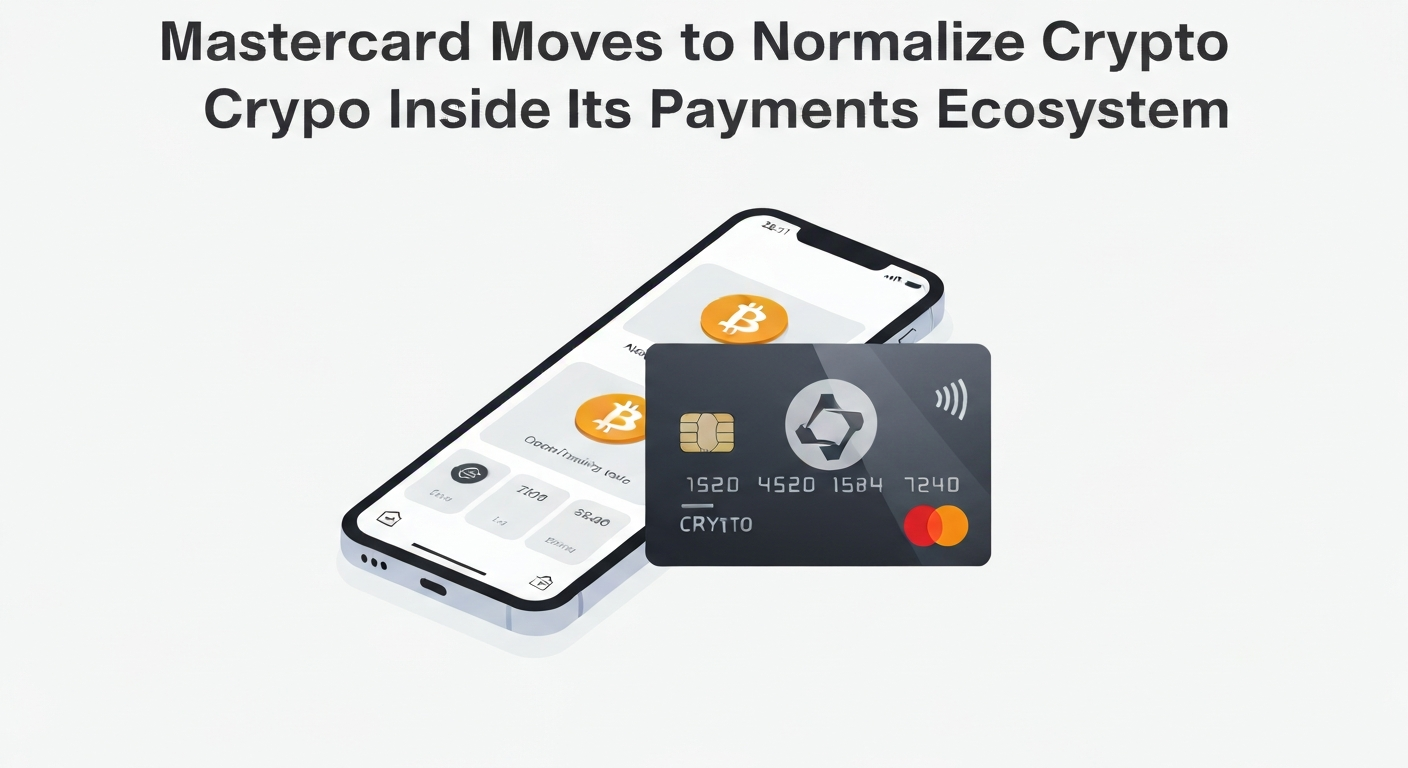
Mastercard has taken its most decisive step toward integrating cryptocurrency into mainstream commerce: deploying its Multi-Token Network (MTN) to enable crypto-funded transactions across its existing 100-million-merchant network without requiring any merchant-side changes. The infrastructure allows consumers to pay from crypto wallets while merchants receive standard fiat settlement — making crypto payments invisible to the receiving end of the transaction.
For the payments industry, this represents the moment crypto shifts from "parallel financial system" to "embedded feature within existing infrastructure" — a normalization that could redirect hundreds of billions in annual crypto transaction volume through Mastercard's rails rather than around them.
How Multi-Token Network Works
The MTN operates as an intermediary layer between crypto wallets and Mastercard's existing settlement infrastructure:
Consumer experience:
- Consumer selects "pay with crypto" in their wallet app (MetaMask, Coinbase Wallet, Trust Wallet)
- Wallet connects to MTN via Mastercard's crypto partner APIs
- Consumer approves the payment amount (displayed in both crypto and fiat)
- MTN executes: crypto deducted from wallet → instant conversion to fiat → Mastercard authorization to merchant
Merchant experience:
- Transaction appears as a normal Mastercard payment
- Standard authorization, clearing, and settlement processes apply
- Merchant receives fiat in their existing merchant account
- Existing reporting, reconciliation, and chargeback processes unchanged
- Merchant doesn't know (or need to know) the consumer paid with crypto
Settlement mechanics:
- MTN partners (Circle, Paxos, Coinbase) provide liquidity for real-time crypto-to-fiat conversion
- Conversion happens at market rate with 25-50bps spread (Mastercard's FX margin)
- Settlement to merchant: same T+1 or T+2 as standard card transactions
- Supported cryptocurrencies: USDC, USDT, PYUSD (stablecoins initially), BTC and ETH (with instant conversion)
The Strategic Logic
Mastercard's crypto integration serves multiple strategic objectives:
Defend against disintermediation. If crypto payments grow through channels that bypass Mastercard (peer-to-peer stablecoin transfers, Lightning Network, account-to-account), the network loses volume. By embedding crypto within its own rails, Mastercard ensures that crypto adoption INCREASES rather than threatens its transaction volume.
Capture new revenue. The crypto-to-fiat conversion generates FX-style revenue (25-50 bps) ON TOP of standard interchange fees. A $100 crypto payment generates: interchange ($1.50-$2.50) + crypto conversion ($0.25-$0.50) = $1.75-$3.00 total take — higher per-transaction revenue than standard card payments.
Expand addressable market. An estimated 560 million people worldwide hold cryptocurrency. Many prefer not to convert to fiat before spending (triggering taxable events, requiring banking relationships, losing exposure). Mastercard-enabled crypto payments let these users spend from crypto wallets directly — capturing transactions that would otherwise occur outside the card network entirely.
Lock in wallet partnerships. By partnering with major crypto wallets (MetaMask: 30M users, Coinbase Wallet: 12M, Trust Wallet: 25M), Mastercard positions itself as the default payment rail for the crypto-native population — creating switching costs that prevent these users from migrating to competitor networks.
Revenue Opportunity
Mastercard processes approximately $9 trillion in annual payment volume. If crypto-funded payments capture even 3% of this within 5 years:
- $9T × 3% = $270B in crypto payment volume
- Revenue per transaction: ~2.5% (interchange + crypto conversion)
- Additional annual revenue: $6.75 billion
For context, Mastercard's total 2025 revenue was approximately $28 billion. A $6.75B crypto contribution would represent 24% revenue growth from this single initiative — explaining why the company is investing heavily despite crypto market uncertainty.
Crypto Partner Program (85+ Firms)
Alongside MTN, Mastercard launched its Crypto Partner Program with 85+ participating companies providing:
- Wallet providers: MetaMask, Coinbase Wallet, Trust Wallet, Ledger
- Exchange on-ramps: Coinbase, Kraken, Bitstamp (card-to-crypto purchasing)
- Stablecoin issuers: Circle (USDC), Paxos (PYUSD), Tether (limited)
- Compliance providers: Chainalysis, Elliptic (transaction monitoring)
- Identity verification: Jumio, Onfido (KYC for wallet-to-card linking)
Partners benefit from Mastercard's merchant network reach; Mastercard benefits from partners' crypto-native user bases. The program creates a comprehensive ecosystem where crypto payments are as accessible as traditional card payments.
Why This Matters
For merchants: No action required to accept crypto payments — they flow through existing Mastercard infrastructure. However, merchants should be aware that crypto-funded transactions may have different chargeback characteristics (some crypto payments are final; Mastercard's dispute resolution still applies to the merchant-side settlement).
For corporate treasurers: Employees and customers paying with crypto through Mastercard create standard card transactions in your accounting systems. No special crypto accounting treatment is needed on the receiving side — the merchant receives fiat through normal channels.
For accounting firms: The tax implication lives entirely on the consumer side: each crypto payment is a disposal triggering capital gains. Advise crypto-holding clients that spending via Mastercard MTN creates the same taxable event as selling crypto and spending the fiat — there's no tax advantage to spending directly.
For Visa and American Express: Competitive pressure to launch equivalent crypto integration is immediate. Visa's USDC settlement layer and Amex's partnership with Abra represent early moves, but neither matches Mastercard's MTN comprehensiveness. Expect matching announcements within 6-12 months.
For payment processors (Stripe, Adyen, Square): Mastercard MTN creates a new payment method to support — similar to Apple Pay or Google Pay integration. Processors that enable merchants to distinguish and report crypto-funded transactions (for analytics, marketing, and customer insight) add value beyond basic acceptance.
For crypto adoption broadly: Making crypto spendable at 100 million merchants without the consumer triggering a separate "sell crypto → receive fiat → spend fiat" process removes the single biggest friction point preventing crypto from functioning as a payment medium rather than a speculative asset.
The key takeaway: Mastercard's Multi-Token Network makes crypto payments invisible to merchants while capturing 2.5% per transaction for Mastercard — potentially adding $6.75B in annual revenue while preventing crypto payment volume from flowing through competing channels that bypass the card network entirely.
Frequently Asked Questions
How is Mastercard integrating crypto into its payment network?
Do merchants need new equipment to accept crypto via Mastercard?
What does this mean for Mastercard's revenue model?
Fintech.News Desk
Editorial TeamThe Fintech.News Desk covers tax and regulation, payments, accounting technology, and AI in finance. We run every story against one test — what does this change about money? — and combine AI-assisted research with editorial review.
Enjoyed this article?
Get stories like this first on our Telegram channel. Subscribed by thousands of fintech leaders.
Join us on TelegramRead Next

Embedded Payments Make Fraud Harder to See and Faster to Hit
Embedded payments hide fraud in plain sight. Learn how seamless integration impacts fraud detection & speed in fintech. Stay ahead of risks.

Inflation Hits 58% of Small Businesses and Pushes Embedded B2B Finance Forward
Inflation hurting SMBs? See how embedded B2B finance offers a lifeline. Discover solutions & strategies for accounting/fintech pros.

Fed Finds Stablecoins Idle, Confirms PYMNTS Usage Gap
Fed report reveals stablecoins mostly idle, used within crypto, not mainstream payments. PYMNTS usage gap confirmed. Fintech/accounting insights here.

68% of Banks Increase Fraud Defense Spending as Account Takeovers Spike
Banks boost fraud defense! 68% increase spending amid account takeover surge. Stay ahead of fintech security trends & protect your institution now.

BILL Expands Supplier Payments Plus Solution
Automate enterprise AP with BILL's Supplier Payments Plus. Enhanced features streamline supplier payments for large enterprises & SMBs. Learn more.

Visa Wants Fraudsters to Pick Another Business
Visa combats evolving fraud with AI. Deep dive into their strategy against sophisticated cybercrime. Insights for fintech & accounting pros.
More in this topic
HSBC Extends Tokenized Deposit Service to US Firms

Fed Rule Changes Would Expand SMB Lending Capacity
Trulioo Pushes Back Beyond One-Time Identity Checks
42% of CFOs Express Interest in Stablecoins as Payments Use Cases Grow

Gig Workers Want Real-Time Pay for Real-Time Work